9/27/10

BPA exposure.

According to the Environmental Working Group, ''trace BPA exposure has been shown (in laboratory tests) to disrupt the endocrine system and trigger a wide variety of disorders, including chromosomal and reproductive system abnormalities, impaired brain and neurological functions, cancer, cardiovascular system damage, adult-onset diabetes, early puberty, obesity and resistance to chemotherapy.''


There have been found detectable levels of BPA in the urine of 93 percent of Americans over the age of six. But to this day, there is no U.S. regulation on BPA contamination of food. Several companies and manufacturers have voluntarily discontinued sales of BPA-based plastics and food containers. But unfortunately, there are many companies that still put out products containing BPA. 


How can one avoid this endocrine disruptor?


1- Avoid canned foods: most tin cans are lined with an epoxy that contains BPA. That includes cans of beans, soups, vegetables, meats, milk, cream, fruits, pie fillings, dog/cat food, chopped/strained tomatoes... and soda. A better choice is to buy the real fresh produce, fruit, dairy and meat. If you must buy packaged, opt for glass, Tetra-Pak versions of the same food, or the frozen version. A few companies, such as Eden Foods, put out BPA-free cans. But because the FDA has not yet approved any other type of liner for canned tomatoes other than the BPA epoxy, all canned tomatoes (including Eden) do contain BPA. As for soda... isn't water  better choice? But if you must have it, they do still make them in glass bottles.


2- Avoid plastic bottles and containers that have the number 3, 6 and 7 on them:
  • Number 3 (polyvinyl chloride) include many cooking-oil bottles, detergents, shampoo and mouthwash bottles, take-out containers, and plastic wrap. 
  • Number 6 (polystyrene) is found in yogurt containers, take-out containers, and styrofoam products such as meat trays, egg cartons, carry-out soda containers, disposable plates and coffee cups. 
  • Number 7 (polystyrene) is present in hard plastic bottles, such as Nalgene bottles, rigid plastic baby bottles and sippy cups. . They are made of polycarbonate plastic, which leaches into the foods/fluids that they hold. Choose Nalgene and baby bottles that state ''BPA-free'' in the packaging. Shatter-resistant-glass baby bottles, and stainless-steel water bottles are also good choices. 
If you must choose plastic, opt for the ones that are safer: 1, 2, 4 and 5. Better yet, opt for glass bottles, cloth or paper bags, and/or stainless-steel containers. A note on plastic #6: it does not contain BPA, but it does contain polystyrene, which is just as toxic (it is also present in second-hand smoke). 


3- Avoid aluminum bottles such as Sigg bottles: they were, until recently, lined with BPA. After BPA was discovered in their bottles, Sigg put out bottles with another kind of lining, which they say is safe- but then again they also still maintain that their old BPA lining is safe as well. A good option is a stainless steel bottle, which has no lining whatsoever.


4- Many receipts nowadays are printed in paper which contains BPA. Since it is hard to know exactly which stores put out receipts which contain BPA, it is best to not let your children handle the receipts; and when you get home, wash your hands. 

9/24/10

Bogus Sellers at Farmer's Markets

Here are 2 articles worth checking out before you head to your nearest farmer's market, ready to spend your precious dollars on supposedly fresh and local foods. It is also good, when shopping for vegetables, to keep in mind what should be growing in your area at that particular time of the year. For example: I know, from talking to the organic farmers in the spring, that most of them were resting their fields during the summer. Since they just recently started planting for the fall, I don't expect to see any vegetables from this area until October. So... if you see beautiful tomatoes, cucumbers, peppers... you might want to ask a lot of questions before you pay the ''organic'' price for them! Each farmer's market has its own regulations. I know for a fact that there people selling stuff from all over the place at the Riverside Arts Market, for example. Ask questions in a way that you don't give them the answer (where, when, what did you use to grow this... instead of ''is this organic?"), and ask other farmers as well. They will tell you if there is any funny business going on.

http://www.nbclosangeles.com/news/local-beat/Hidden-Camera-Investigation-Farmers-Markets-103577594.html

NBC Los Angeles Uncovers Local Farmers Market Frauds

farmers_markets
A few bad apples may be lurking behind the farmers market sign. (Photo: Reuters Pictures).
Farmers markets have skyrocketed in popularity as the demand for organic, locally-grown, pesticide-free produce has grown in recent years.
But can you be sure that the fresh fruits and veggies you buy at a neighborhood market are actually the sustainable, healthy, local goods they're billed as?
Turns out, sometimes it's rather tough.
The NBC affiliate in Los Angeles went undercover at various farmers markets in Southern California.
They found numerous instances of lying and false claims:
We found farms full of weeds, or dry dirt, instead of rows of the vegetables that were being sold at the markets. In fact, farmers markets are closely regulated by state law. Farmers who sell at these markets are supposed to sell produce they've grown themselves, and they can't make false claims about their produce.
Farmers markets in California (and many other states) are tightly regulated to ensure that consumers get exactly what they're paying for. Click over to NBC Los Angeles to get the full story, and let us know in the comments below if you've ever been suspicious of the fruits and vegetables you bought at a farmers market.
And to make sure your beets and carrots aren't pesticide-enriched imposters, NBC LA has these tips:
Operators of farmers markets we spoke to suggest shoppers get to know vendors they buy from, and ask them a lot of questions. Ask for the exact location of the farm where the produce is grown. If they claim their produce is "pesticide-free," ask them what methods they use to control pests on their crops. Ask exactly when the produce was picked. If the farmer can't give you specific answers, or seems unwilling to answer your questions, market operators say you should walk away.

States expand efforts to combat 'funny honey'

In this photo taken Sept. 23, 2010, honey bees on a comb at the North Carolina Arboretum in Raleigh, N.C. (AP Photo/Jim R. Bounds)AP – In this photo taken Sept. 23, 2010, honey bees on a comb at the North Carolina Arboretum in Raleigh, …
RALEIGH, N.C. – You might call them the Honey Police — beekeepers and honey producers ready to comb through North Carolina to nab unscrupulous sellers of sweet-but-bogus "funny honey."
North Carolina is the latest state to create a standard that defines "pure honey" in a bid to curb the sale of products that have that label but are mostly corn syrup or other additives. Officials hope to enforce that standard with help from the 12,000 or so Tar Heel beekeepers.
"The beekeepers tend to watch what's being sold, they watch the roadside stands and the farmer's markets," said John Ambrose, an entomologist and bee expert at North Carolina State University who sits on the newly created Honey Standards Board.
Florida was the first state to adopt such standards in 2009. It's since been followed by California, Wisconsin and North Carolina. Similar efforts have been proposed in at least 12 other states, including North and South Dakota, the nation's largest producers of honey, together accounting for roughly one-third of U.S. output.
Beekeepers and honey packers around the country are fuming about products masquerading as real honey, and they hope the state-by-state strategy will secure their ultimate goal: a national rule banning the sale of any product as pure honey if it contains additives.
Americans consume about 350 million pounds of honey per year, but just 150 million pounds are made domestically, creating a booming market for importers and ample temptation to cut pure honey with additives such as corn syrup that are far less expensive to produce.
This month, the U.S. attorney's office in Chicago announced the indictments of 11 German and Chinese executives and six companies on charges that they avoided nearly $80 million in honey tariffs and sold honey tainted with banned antibiotics.
The scale of the problem nationwide is hard to gauge. It's largely a concern for the big producers who make most of America's honey, said Bob Bauer, vice president of the National Honey Packers and Dealers Association.
"The honey industry is looking to be proactive and take whatever steps are necessary not only to keep it from becoming a widespread problem, but to get rid of it entirely," he said.
The most passionate supporters of the laws tend to be beekeepers and other small producers outraged at what they see as the corruption of their craft.
"They're trading on the good name of honey to sell their product," Kenosha, Wis., beekeeper Tim Fulton said of phony honey peddlers.
Ambrose said the North Carolina board — formed by the state Department of Agriculture and Consumer Services and the state Beekeepers Association — won't be a "honey patrol."
The board will instead respond to complaints about improperly marketed honey, which under state law is now defined as what honeybees produce: no more, no less. Once a complaint has been received, a state-approved lab will test the product. If it's not pure honey, the state can order it to be removed from sale and impose fines for subsequent violations.
"You can go to roadside stands throughout the western part of the state and they'll try to sell you Karo syrup and swear it's sourwood honey," said Charles Heatherly, a North Carolina beekeeper.
Sourwood — Heatherly calls it "the Cadillac of North Carolina honey" — is mostly found in the state's mountainous west. It can cost up to $10 a pound, making it an attractive target for adulteration.
It was a similar impersonation of local honey that provoked Nancy Gentry, a beekeeper who owns Cross Creek Honey in Interlachen, Fla., to launch a bid to get a honey standard not just in her home state, but around the country.
"People were taking raw honey, adding high fructose corn syrup and marketing it as grade A USDA No. 1 honey, but there is no such thing," said Dick Gentry, Nancy's husband and a retired trial lawyer who helped steer the campaign in Florida.
But the real sting in the Florida provision, and in standards adopted in California, Wisconsin and North Carolina, is that it makes it easier to file lawsuits against purveyors of bogus honey.
Agencies have been reluctant to create standards for honey ever since a Michigan jury in 1995 found in favor of a honey processing firm that had been accused of cutting the product with an additive. The jurors said there weren't enough regulations governing honey to make the charge stick and that the government failed to identify the additive.
Under the new laws, it isn't necessary to know out what's being added to honey. Any additive, from cane sugar to corn syrup, deprives it of the label "pure honey."
That could prompt retailers or beekeepers to file more lawsuits.
"For us, it is through the civil courts, then, that we take back the product," Nancy Gentry told an industry group in Fresno, Calif., according to a transcript of her speech. "We crush unscrupulous packers and throw out honey pretenders."
The U.S. Food and Drug Administration has worked to block the sale of honey contaminated with potentially harmful chemicals, and it's reviewing a petition seeking a national honey standard, spokeswoman Siobhan DeLancey said.
In the meantime, North Carolina beekeepers promise to keep on the lookout to ensure every jar of honey holds what the label says.
"Some of the people who think they've been buying sourwood all these years have actually been buying corn syrup, and they have no idea what they're missing," Ambrose said.

Tomatoes and BPA

Our family loves eating pasta, polenta, pizza, lasagna... so pasta sauce is a definitely a big, important item in our household. We love making it, and have always used Pommi chopped (not strained) tomatoes to prepare it. We like it because, even though it is not organic, they do come from Italy (good sign as far as no use of pesticides goes), they taste great, and are relatively cheap compared to their organic competitors. 
Since I found out that Eden puts out BPA-free cans, I had recently tried a few times to use Eden chopped tomatoes, but was surprised and frustrated to find out a few days ago that Eden, when it comes to tomatoes, is forced to put out BPA-lined cans. That is because the FDA has not approved ''non-BPA'' liners for cans that contain tomatoes. 
Expletives at the FDA aside, I was happy to receive an email from a good friend with this blog on tomatoes! Looks like our household will be going back to Pommi's. 
But I am also curious to see what the new Eden glass strained tomatoes are like. I still don't know what the lid lining of those jars are made of, but that is definitely a better alternative than the cans. 

9/23/10

CFL's

LED bulb
A friend of mine asked me recently if I knew anything about CFL's and dirty electricity. No, I did not. So... I got on the internet to look it up.
CFL, first of all, means compact fluorescent lamp, as opposed to the old-fashioned incandescent lamp.
A lot of people, my household included, are starting to switch to CFL's in order to be more environmentally conscious and/or save energy. In Canada, in fact, households will not be allowed to have the old-fashioned incandescent lights after 2012.
The problem is, apparently a number of people are having reactions to their CFL's. Headaches, migraines,  skin rashes and itchiness are a few of the complaints. These symptoms appear to stem from the amount of UV radiation that the light puts out. Since these complaints have surfaced, it seems that the industry is starting to make CFL's that have protection from the UV radiation. But when I looked around in different stores here in Jacksonville, I honestly could not tell which ones had this protection, and which ones did not.
One more fact I did not know when I bought all these CFL's to replace the flood lights in my house: CFL's put out an incredibly strong magnetic field. It not only reaches the up to 800 in the micro-surge meter, as opposed to incandescent bulbs that stay around 26. CFL's magnetic field also oscillate wildly, which is also not good for us either. Since I have known for a while that strong magnetic fields (such as power plants) are harmful to humans, that struck a nerve. Again, I went to the store and looked around, but could not find any information on the packaging that would tell me anything about magnetic emissions.
Since I could not find enough information to put my mind at ease, or merely satisfy my curiosity, I decided to stay on the safe side until I know more about CFL's, and in particular the ones that I have at home. I took out all the CFL's from my house. I put back the incandescent bulbs that I still had, and went and bought LED's (I found them at Home Depot) for the ones that needed replacement. LED's have come down considerably in price, so if you replace them as your incandescents burn out, they are affordable; they also last up to 20 years, which is nice. I did read up on them, and they seem to have no issues as far as UV radiation is concerned. They do emit a slightly higher magnetic field than the incandescent bulbs, but it is stable and stays below 50 in the micro-surge meter, which is the number considered to be safe for humans.
I have not had the time to research info on microsurge meters, but if I do end up finding one, then I will put one of the CFL's back up, and measure its magnetic output, just out of curiosity. But that will still not tell me enough about the UV emission to feel comfortable having them in the ceilings and on the walls around us.


More info on this:

9/20/10

Microwaves

When I was growing up in Brazil, I remember being warned by macrobiotic counselors against using microwaves. I was told the same here in the States by people in the macrobiotic circles. They were concerned about the quality of the food that was cooked in those devices, as well as the exposure to the machine itself.
I have never had a microwave in my home, but wanted to find out more about it so I could actually really know why I really shouldn't have one. So I read and researched for a while, but never found anything worth posting. Today, while looking up EMF's, I stumbled on this little article, along with links to other articles and studies on the subject. 
I like this article because it explains in a simple way how food is altered when it is cooked in a microwave. I also added another link that talks about microwaves and magnetic field exposure (EMF's):

Here is the article, followed by other links on the subject:

4
MAI
2004

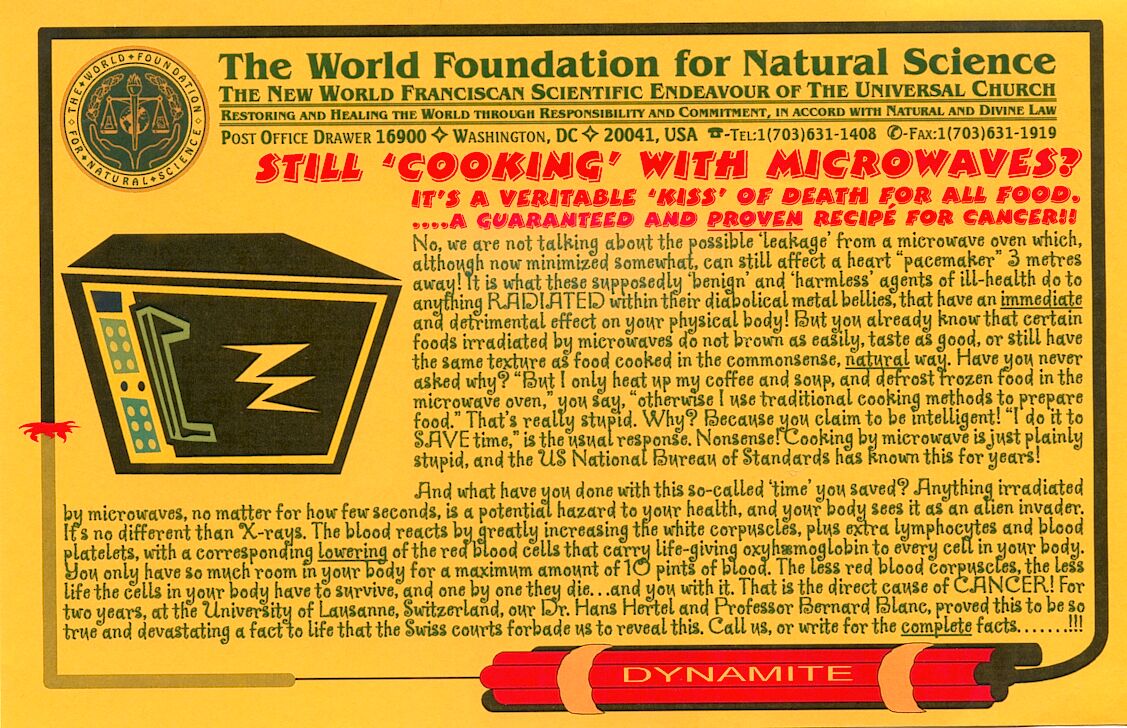
Still 'Cooking' With Microwaves?

Please spread it widely:
http://www.buergerwelle.de/pdf/still_cooking_with_microwaves.jpg

Hans U. Hertel

In the tiny town of Wattenwil, near Basel in Switzerland, there lives a scientist who is alarmed at the lack of purity and naturalness in the many pursuits of modern mankind. He worked as a food scientist for several years with one of the many major Swiss food companies that do business on a global scale. A few years ago, he was fired from his job for questioning procedures in processing food because they denatured it.

"The world needs our help," Hans Hertel told Tom Valentine as they shared a fine meal at a resort hotel in Todtmoss, Germany. "We, the scientists, carry the main responsibility for the present unacceptable conditions. It is therefore our job to correct the situation and bring the remedy to the world. I am striving to bring man and techniques back into harmony with nature. We can have wonderful technologies without violating nature."

Hans is an intense man, driven by personal knowledge of violations of nature by corporate man and his state-supported monopolies in science, technology and education. At the same time, as the two talked, his intensity shattered into a warm smile and he spoke of the way things could be if mankind's immense talent were to work with nature and not against her.

Hans Hertel is the first scientist to conceive of and carry out a quality study on the effects of microwaved nutrients on the blood and physiology of human beings. This small but well-controlled study pointed the firm finger at a degenerative force of microwave ovens and the food produced in them. The conclusion was clear: microwave cooking changed the nutrients so that changes took place in the participants' blood; these were not healthy changes but were changes that could cause deterioration in the human systems.

Working with Bernard H. Blanc of the Swiss Federal Institute of Technology and the University Institute for Biochemistry, Hertel not only conceived of the study and carried it out, he was one of eight participants.

"To control as many variables as possible, we selected eight individuals who were strict macrobiotic diet participants from the Macrobiotic Institute at Kientel, Switzerland," Hertel explained. "We were all housed in the same hotel environment for eight weeks. There was no smoking, no alcohol and no sex."

One can readily see that this protocol makes sense. After all, how could you tell about subtle changes in a human's blood from eating microwaved food if smoking, booze, junk food, pollution, pesticides, hormones, antibiotics and everything else in the common environment were also present?

"We had one American, one Canadian and six Europeans in the group. I was the oldest at 64 years, the others were in their 20s and 30s," Hertel added.

Valentine published the results of this study in Search for Health in the Spring of 1992. But the follow-up information is available only in a later edition, and also in Acres, USA.

In intervals of two to five days, the volunteers in the study received one of the food variants on an empty stomach. The food variants were: raw milk from a biofarm (no. 1); the same milk conventionally cooked (no. 2); pasteurised milk from Intermilk Berne (no. 3); the same raw milk cooked in a microwave oven (no. 4); raw vegetables from an organic farm (no. 5); the same vegetables cooked conventionally (no. 6); the same vegetables frozen and defrosted in the microwave oven (no. 7); and the same vegetables cooked in the microwave oven (no. 8). The overall experiment had some of the earmarks of the Pottenger cat studies, except that now human beings were test objects, the experiment's time-frame was shorter, and a new heat form was tested.

Once the volunteers were isolated at the resort hotel, the test began. Blood samples were taken from every volunteer immediately before eating. Then blood samples were taken at defined intervals after eating from the above-numbered milk or vegetable preparations.

Significant changes were discovered in the blood of the volunteers who consumed foods cooked in the microwave oven. These changes included a decrease in all haemoglobin values and cholesterol values, especially the HDL (good cholesterol) and LDL (bad cholesterol) values and ratio. Lymphocytes (white blood cells) showed a more distinct short-term decrease following the intake of microwaved food than after the intake of all the other variants. Each of these indicators point in a direction away from robust health and toward degeneration. Additionally, there was a highly significant association between the amount of microwave energy in the test foods and the luminous power of luminescent bacteria exposed to serum from test persons who ate that food. This led Hertel to the conclusion that such technically derived energies may, indeed, be passed along to man inductively via consumption of microwaved food.

"This process is based on physical principles and has already been confirmed in the literature," Hertel explained. The apparent additional energy exhibited by the luminescent bacteria was merely extra confirmation.

"There is extensive scientific literature concerning the hazardous effects of direct microwave radiation on living systems," Hertel continued. "It is astonishing, therefore, to realise how little effort has been made to replace this detrimental technique of microwaves with technology more in accordance with nature.

"Technically produced microwaves are based on the principle of alternating current. Atoms, molecules and cells hit by this hard electromagnetic radiation are forced to reverse polarity 1 to 100 billion times a second. There are no atoms, molecules or cells of any organic system able to withstand such a violent, destructive power for any extended period of time, not even in the low energy range of milliwatts.

"Of all the natural substances-which are polar-the oxygen of water molecules reacts most sensitively. This is how microwave cooking heat is generated-friction from this violence in water molecules. Structures of molecules are torn apart, molecules are forcefully deformed (called structural isomerism) and thus become impaired in quality...(excerpt)

More under http://www.all-natural.com/microwa1.html

MICROWAVE COOKING is Killing You!
Microwave Cooking Hazards
http://omega.twoday.net/stories/283082/

Microwaves are a hazard to life
http://omega.twoday.net/stories/189655/

Microwave–ovens cause cancer after all
http://omega.twoday.net/stories/189666/

Man turns the Earth into a Microwave–Oven
http://omega.twoday.net/stories/189645/

Food prepared in the microwave oven leads to changes in the blood
http://www.buergerwelle.de/pdf/microwave_cooking.pdf

MICROWAVE DANGERS: How unseen frequencies can harm your health
http://www.choosecra.com/htmlpages/news/reports/microwavedanger.html

Radiation Ovens: The Proven Dangers of Microwaves
http://omega.twoday.net/stories/485972/

The Hidden Hazards Of Microwave Cooking
http://omega.twoday.net/stories/485968/

Microwave oven info
http://omega.twoday.net/stories/491151/

http://omega.twoday.net/topics/Mikrowellen/


More links:
http://www.jrussellshealth.com/microwaves.html
http://omega.twoday.net/stories/192056/
http://www.buergerwelle.de/pdf/nine_degrees_of_health_hazard_for_electromagnetic.pdf
http://www.the7thfire.com/cell_phones.htm

9/16/10

U.S. Meat Farmers Brace for Limits on Antibiotics

By ERIK ECKHOLMSeptember 14, 2010


RALSTON, Iowa — Piglets hop, scurry and squeal their way to the far corner of the pen, eyeing an approaching human. “It shows that they’re healthy animals,” Craig Rowles, the owner of a large pork farm here, said with pride.
Mr. Rowles says he keeps his pigs fit by feeding them antibiotics for weeks after weaning, to ward off possible illness in that vulnerable period. And for months after that, he administers an antibiotic that promotes faster growth with less feed.
Dispensing antibiotics to healthy animals is routine on the large, concentrated farms that now dominate American agriculture. But the practice is increasingly condemned by medical experts who say it contributes to a growing scourge of modern medicine: the emergence of antibiotic-resistant bacteria, including dangerous E. coli strains that account for millions of bladder infections each year, as well as resistant types of salmonella and other microbes.
Now, after decades of debate, the Food and Drug Administration appears poised to issue its strongest guidelines on animal antibiotics yet, intended to reduce what it calls a clear risk to human health. They would end farm uses of the drugs simply to promote faster animal growth and call for tighter oversight by veterinarians.
The agency’s final version is expected within months, and comes at a time when animal confinement methods, safety monitoring and other aspects of so-called factory farming are also under sharp attack. The federal proposal has struck a nerve among major livestock producers, who argue that a direct link between farms and human illness has not been proved. The producers are vigorously opposing it even as many medical and health experts call it too timid.
Scores of scientific groups, including the American Medical Association and the Infectious Diseases Society of America, are calling for even stronger action that would bar most uses of key antibiotics in healthy animals, including use for disease prevention, as with Mr. Rowles’s piglets. Such a bill is gaining traction in Congress.
“Is producing the cheapest food in the world our only goal?” asked Dr. Gail R. Hansen, a veterinarian and senior officer of the Pew Charitable Trusts, which has campaigned for new limits on farm antibiotics. “Those who say there is no evidence of risk are discounting 40 years of science. To wait until there’s nothing we can do about it doesn’t seem like the wisest course.”
With the backing of some leading veterinary scientists, farmers assert that the risks are remote and are outweighed by improved animal health and lower food costs. “There is no conclusive scientific evidence that antibiotics used in food animals have a significant impact on the effectiveness of antibiotics in people,” the National Pork Producers Council said.
But leading medical experts say the threat is real and growing. Proponents of strong controls note that the European Union barred most nontreatment uses of antibiotics in 2006 and that farmers there have adapted without major costs. Following a similar path in the United States, they argue, would have barely perceptible effects on consumer prices.
Resistance can evolve whenever drugs are used against bacteria or other microbes because substrains that are less susceptible to the treatment will survive and multiply.
Drug use in humans, including overuse and misapplication, clearly accounts for a large share of the surge in antibiotic resistant infections, a huge problem in hospitals in particular. Yet biologists and infectious disease specialists say there is also enormous circumstantial and genetic evidence that antibiotics in farming are adding to the threat.
Livestock and poultry have been identified as the most likely sources of drug-resistant strains of microbes like salmonella and campylobacter that have caused outbreaks of severe intestinal illness in people and of E. coli strains that cause serious bladder, blood and other infections. (Resistant strains have not been implicated in the recent outbreak of salmonella contamination in eggs.)
In a letter to Congress in July, Dr. Thomas R. Frieden, director of the Centers for Disease Control and Prevention, cited “compelling evidence” of a “clear link between antibiotic use in animals and antibiotic resistance in humans.”
As drug-resistant strains of microbes evolve on the farms, they are passed along in meat sold in grocery stores. They can infect people as they handle the uncooked product or when eating, if cooking is not thorough. The dangerous strains can also enter the environment via manure or the clothes of farm workers.
Genetic studies of drug-resistant E. coli strains found on poultry and beef in grocery stores and strains in sick patients have found them to be virtually identical, and further evidence also indicated that the resistant microbes evolved on farms and were transferred to consumers, said Dr. James R. Johnson, an infectious-disease expert at the University of Minnesota. Hospitals now find that up to 30 percent of urinary infections do not respond to the front-line treatments, ciprofloxacin and the drug known as Bactrim or Septra, and that resistance to key newer antibiotics is also emerging. E. coli is also implicated in serious blood, brain and other infections.
“For those of us in the public health community, the evidence is unambiguously clear,” Dr. Johnson said. “Most of the E. coli resistance in humans can be traced to food-animal sources.”
The proposed Food and Drug Administration guidelines focus on the use of antibiotics to speed growth. Just how antibiotics have this effect, which has been known for decades, is unclear, but scientists suspect that the drugs improve the absorption of nutrients as they prevent low-grade disease.
Mr. Rowles, the proprietor of Elite Pork and a trained veterinarian himself, estimates that by feeding his pigs an antibiotic in their final months he is saving $1 to $3 per animal in feed costs. For the consumer, this is negligible, but from his perspective it looms larger because, he said, in good years his net profit is only $7 to $10 per animal.
More contentious is the routine use of antibiotics to prevent disease, as Mr. Rowles and other pork producers do with newly weaned pigs.
Dr. James McKean, an extension veterinarian at Iowa State University, said experience in Denmark, Europe’s leading pork producer, showed that ending the practice would result in more illness, suffering and death among pigs, and cause a jump in antibiotic treatments of actual disease.
Dr. McKean estimated that a ban on most nontreatment uses of antibiotics would raise the cost of pork by 5 cents a pound.
Others counter that farmers in Denmark have learned to hold down illness in young pigs by extending the weaning period, altering feeds and providing more space and veterinary scrutiny of the animals. Some of the drugs used in prevention by farmers like Mr. Rowles would also be permitted under the measure before Congress because they are not used in human medicine.
“In the end, the producers will do what is right,” Mr. Rowles said. “We will make sure we deliver a product that meets the needs of consumers.”
“My only concern is that we make decisions in a scientific fashion, not a political fashion,” he said.

9/15/10

Big Corn wants to change "High Fructose Corn Syrup" to "Corn Sugars"

The US Corn Refiners Association has petitioned the FDA for permission to change the name "High Fructose Corn Syrup" to the much more innocuous-sounding "Corn Sugars." This comes as 58% of Americans say they are concerned about HFCS's impact on their health. HFCS is a heavily subsidized industrial byproduct of the corn industry, and is ubiquitous in American processed food -- everything from Rice Krispies to "healthy" granola bars.
HFCS isn't particularly high in fructose, as it turns out -- the name is a hang-over from the 1970s, when it first came into popular use. But even though "Corn Sugars" might be more descriptive, the name-change is clearly a move intended to confuse Americans who have slowly but surely come to reject products with HFCS on the ingredients list (when they can find alternatives that aren't laden with HFCS, that is). Maybe the FDA should approve the move, but require a ten year period when the ingredient is written as "Corn Sugars (formerly High Fructose Corn Syrup)."

9/12/10

Canola Oil

I was talking to a friend today, and we were trying to figure out where on earth Canola Oil comes from. I have used it for baking many times, and had it on my shopping list for my next supermarket/health food store trip. I then recalled being told, in macrobiotic classes many years ago, not to use it; but could not exactly remember why. So I decided to do a little investigation. Here are a few facts that I discovered:
  • Canola oil is short for Canada Oil. 
  • It is a made-up word for the oil that comes from the Rape Seed. 
  • It was invented in the 1970's
  • Most of it is produced these days from genetically engineered Rape Seeds.
  • GMO Rape Seeds are sold by Monsanto. 
  • Canola oil, whether organic or not, is refined at incredibly high temperatures, which adversely affects the composition of the oil
  • Margarine is made of canola oil... and soy fats (oils)...
  • It is cheap to produce, therefore you will find it in most processed foods
Personally, I will no longer use Canola Oil for any cooking or baking. Olive Oil and Butter (organic, grass-fed) taste better anyway, and have both been around for thousands of years- for me, long enough to know they are good, real foods. 
For more detailed info on Canola Oil, please go to:


9/10/10

Another Alternative to Plastic Sandwich Bags


Pack School Lunches With DIY Eco-Love

posted by Ronnie Citron-Fink Aug 29, 2010 9:07 am
Pack School Lunches With DIY Eco-Love
    Summer is fading fast, and while it is bittersweet to say goodbye to those lazy, hazy days of summer, the start of a new school year brings expectations of new beginnings.
    In my post about ditching the sandwich bags, it was noted that, “The average American school kid generates 67 pounds of discarded school lunch packaging waste per year. That is more than 18,000 pounds yearly for the average-sized elementary school.”
    Why not show your children you care about them and the environment by beginning the school year with these two eco-lunch alternatives to paper andplastic lunch waste that you can make yourself?
    2 DIY Projects That Help Cut School Lunch Waste
    DIY Eco-Lunch Mat

    These Lunch Mats, designed by Creative Kismet are just so cute. Check out how she included a reusable napkin and cutlery. Using eco-fabric or leftover scraps would be greenest choice to create these mats. Here’s the Lunch Mat tutorial.
    DIY Eco-Sandwich Wrap

    If you haven’t already found an ecological alternative for wrapping your child’s lunch, try making this Sandwich Wrap. Here’s the Sandwich Wrap tutorial.
    Ronnie Citron-Fink is a writer and educator. Ronnie regularly writes about sustainable living for online sites and magazines. Along with being the creator of www.econesting.com, Ronnie has contributed to numerous books about green home design, DIY, children, and humor. Ronnie lives the Hudson Valley of New York with her family.