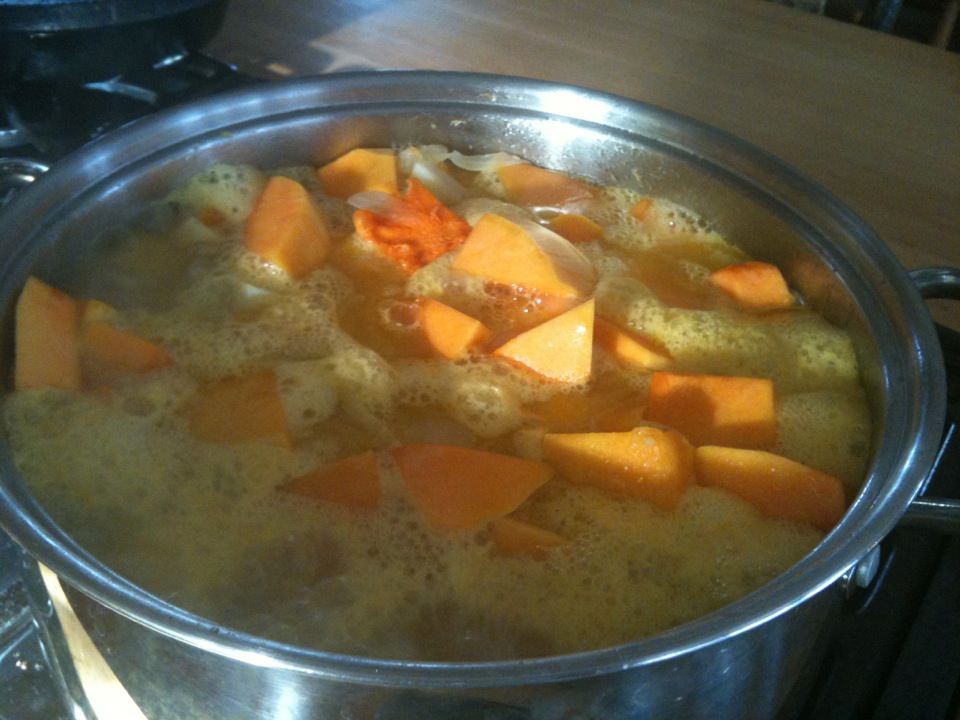
Squash soup has been a staple in our home for years now. It is easy to make, and so comforting and satisfying. This is the recipe I use; I love it because it has no precise measurements, and gives me a completely different outcome every time I make it.
For the main, basic ingredients, I use olive oil, butter, sea salt, a medium butternut squash, and a big yellow onion- 2 or 3 medium-sized ones will do the job as well... they just involve more pealing and crying.
For the ''side'' accompanying ingredients, I use either 1 or 2 potatoes, or 1 sweet potato for a stronger flavor; sometimes I will throw in a small carrot, or an apple, or orange, depending on what I find in the fridge that needs to be used. And heavy cream...
The secret to this soup is to cook the onions just right. Cut the onions into half-moons (C shapes), and put them in a big pot (preferably a thick one), along with enough olive oil to cover the bottom of the pot, about 3 tablespoons of butter, and salt to taste. Turn the fire to medium and let the onions cook, stirring every once in a while to make sure the bottom doesn't burn, until they are golden. By doing that, I get the full flavor of the onions, which give the soup its sweetness and body.
While the onions cook, I wash and cut the potatoes- no need to peel them, as their skin is nutritious as well. Then I peel (with a peeler), scoop the seeds out, and chop the squash any way I can without cutting myself or getting squash skin under my nail (very painful, not recommended). I also use that time to clean up all the peels and keep the counter clean. When the onions are nice and golden, I throw the potatoes/carrots/apple or orange in, and mix. Then I put the cut-up squash in, and mix. Mixing is very important in order to coat all the vegetables with the butter/oil/salt mixture, and keep them from tasting like ''boiled vegetables.'' I then add water to cover (just like in the picture above), turn the fire to ''high'' until it starts to boil, and turn it to ''low'' to simmer, with or without a lid. I use I lid if I am concerned about a bug falling on the soup (it happens); in that case, I keep the lid ajar so that the soup does not boil over.
I cook the soup for about 20 minutes, or until all the vegetables are soft when pricked with a fork, and turn the fire off. If I have a chance, I let it cool a bit so I don't burn myself while handling it- but that is not totally necessary, in the interest of time. I then put the soup, a bit at a time, in the blender. Once the soup has a nice and creamy consistency, I empty it onto a container or pot. When I am ready to warm it up in order to serve/eat it, I add a bit of heavy cream to it, which makes it taste incredible. Don't let it boil though... very important when using heavy cream. Milk will also do, but really, there is nothing like heavy cream...
1/22/12
1/17/12
New bread in town!
Their bread is made fresh on the day of delivery, with organic ingredients, and local when possible. This is a typical ingredient list: organic 100% whole wheat flour, brown rice, water, vegan sugar, raisin juice, salt, yeast, pumpkin seeds. No preservatives, stabilizers, dough conditioners, or any other bizarre ingredients.
Their CSL (Community Supported Loaves) offer the following:
- Standard four-week subscription is $24 (Tuesday or Saturday).
- Every other week (four week period) at $12 (Tuesday or Saturday). Or
- Twice a week for four weeks at $42 (Tuesday and Saturday)
They hope to soon establish a pick-up point at the Beaches Market on Saturdays.
For more info, please contact:
Communityloaves@gmail.com
(904) 419-7899.
1/13/12
Studying...
I had not taken any science in Brazil. I studied in a public high-school, which meant that science labs were non-existent. They actually had existed at some point, since the beautiful old building we studied in had once belonged to a prestigious German High-School. The steps were made of marble, the windows were made of elaborate stained-glass. But everything had degraded, and the labs had been vandalized, or literally burnt down. So no science lab. We memorized periodic tables and such, but it pretty much stopped there, since teachers were often absent and there was no such thing as substitute teachers- we just had no class.
In college, since my major was music performance, there was never a need to study any science whatsoever. It is interesting to go through life without any knowledge of science: math, biology, chemistry, anatomy... I never knew how much I was missing until being exposed to it. It opens up a new side of my brain. A thinking side. I could have used it years ago, when I was in college, to help organize my life and not be completely stressed out of my mind the whole 6 years that it took to go through Bachelor's and Master's of music. It would probably have helped me practice more efficiently as well, instead of emotionally. Divide problems into sections, not be overwhelmed by the entire task.
I have now gone through College Algebra, Psychology Intro, Anatomy and Physiology, and Statistics. Yesterday I had my first Chemistry class, and start Anatomy/Physiology II this upcoming Saturday.
As difficult as it may be to balance these classes with family, work, and exercise... I feel that I have actually improved my mental capacity. I can memorize faster, and process everyday problems into compartments and subdivisions which allow for faster and simpler thinking/problem solving. It is also very satisfying to look at my hands, for example, and understand what my phalanges are doing, what the muscles are capable of, how sensitive the nerves are, and how much of our bodies is still unknown.
I am not sure yet what will come out of all these classes. They are all prerequisites for an accelerated Bachelors of Nursing Degree, which I will be able to apply for next fall if I so choose...
Meanwhile, I will try to be remember to be grateful for the gift that is learning, and enjoy it as much as I can, especially when studying through the night...
1/7/12
Why I cook...
| Getting ready for pizza... |
I have heard time and again about how important it is to cook and eat at home. But when I hear about it in the news, it mainly refers to meals and ''family time.'' To tell you the truth, ''family time/meals'' are, for me, one of the most stressful parts of the day.
Cooking, trying to get the kids to eat what I serve them, stopping their fights during the meals, cleaning up after them… why bother to cook, then?
| Squash soup in the making... |
Cooking is the simplest, easiest, and cheapest way to take care of myself and my family, stay healthy, and lean.
Yes, it takes work, time and planning. But with time it becomes second nature, just like driving a car. No need to consult recipes and how-to books, no need to make fancy and involved meals. Just simple, intuitive cooking of good, wholesome food.
When I cook, I eat foods that I don't normally find in restaurants. Foods that seem to be ''beneath'' restaurant grade, such as collards, mustard, turnip greens… chinese cabbage, cabbage, beets, turnips, beans, brown rice… those are the foods that nourish my body and sustain the health of my family. They cost little, and yet give sustenance. When I cook, I control the quality of the cookware, as opposed to the aluminum pots and pans of most restaurants…
| Argentinian Tortilla in the making... |
My mother cooked everyday, both in Argentina and in Brazil. But I think she forgot that she actually had to teach us how to do it in order for us to learn. When I came to America, I ate Ramen noodles, hot-dogs, tuna sandwiches, eggs, pizza, pasta… I was constantly sick with colds, flu, and ear infections.
Then, one incredible day, my sister came to visit me and, horrified at what I was eating, took me to the supermarket. We bought a variety of fruits,vegetables, grains and beans, and she started to show me how to cook them. I started to feel so much livelier cooking this way, that I have kept doing it now for 17 years and counting…
| Roasted beets in the making... |
I wasn't born knowing how to cook. The first time I made a pot of black beans it was a disaster. I poured red wine in it, and it tasted like shit. I had to throw the whole batch away. But I eventually learned how to cook a variety of beans and grains, as well as all kinds of vegetables.
How does cooking my own food affect my health? The kids go to the doctor once a year- for a check up. No ear infections, no allergies, colds or flu. No trips to the doctor for us adults either.
| Lasagnas in the making... |
Subscribe to:
Posts (Atom)